About ATC One
ATC One is an AI-powered practice platform for real-world Air Traffic Control communications, combining voice-based interaction with intelligent diagrams, quiz-based validation, and scenario-driven exercises tuned equally for student pilots and aviation enthusiasts.
Pilots engage across the full communication cycle, including ATIS comprehension, pilot request formulation, clearance interpretation, taxi route visualization, readback drills, and holding pattern entry decision-making. Each system is designed to reflect how communication and procedures unfold in real cockpit operations.
The platform integrates multiple practice modes, including voice response exercises with real-time feedback, interactive airport diagrams that validate taxi routes with high precision, and structured quizzes that evaluate comprehension and decision-making across different scenarios.
All exercises are manually designed and reviewed by Certified Flight Instructors (CFIs) and aviation professionals, ensuring accuracy, realism, and alignment with real-world procedures.
With hundreds of exercises and new content added regularly, ATC One supports VFR, IFR, and mixed operational scenarios across multiple difficulty levels while reinforcing FAA and ICAO phraseology standards.
Available in multiple languages on mobile and tablet devices through the App Store and Google Play.
Designed for real-world aviation training
A focused set of tools built to develop accurate, confident radio communication.
Real-time voice recognition
An advanced AI that listens, understands, and recognizes correct use of official aviation phraseology and phonetics.
Instant feedback
Clear, actionable feedback after each session, covering accuracy, phraseology, and areas for improvement.
Progressive difficulty
Multiple complexity levels across all practice modes to support consistent, measurable improvement.
Proprietary AI model
A custom-built AI model optimized for official aviation standards, including ICAO phraseology, NATO phonetics, and FAA procedures.
Track your progress
Detailed performance metrics to monitor progress, identify weak areas, and track improvement over time.
Ultra-realistic environments
Authentic radio effects, cabin noise, static, and real-world scenarios for immersive training.
Who is ATC One for?
Student pilots
Build confidence before your first flight with interactive voice and diagram exercises focused on clearances, route interpretation, pattern work, and foundational airborne procedures.
Licensed pilots
Stay current on phraseology, sharpen communications for complex requests and busy airspace, and rehearse realistic operations with structured AI feedback.
Aviation enthusiasts
Understand the fascinating language of aviation communications and gain insight into how pilots and controllers coordinate safely.
Practice the way you learn best
Seven focused tools to build precise, confident aviation communication skills

Readback drills
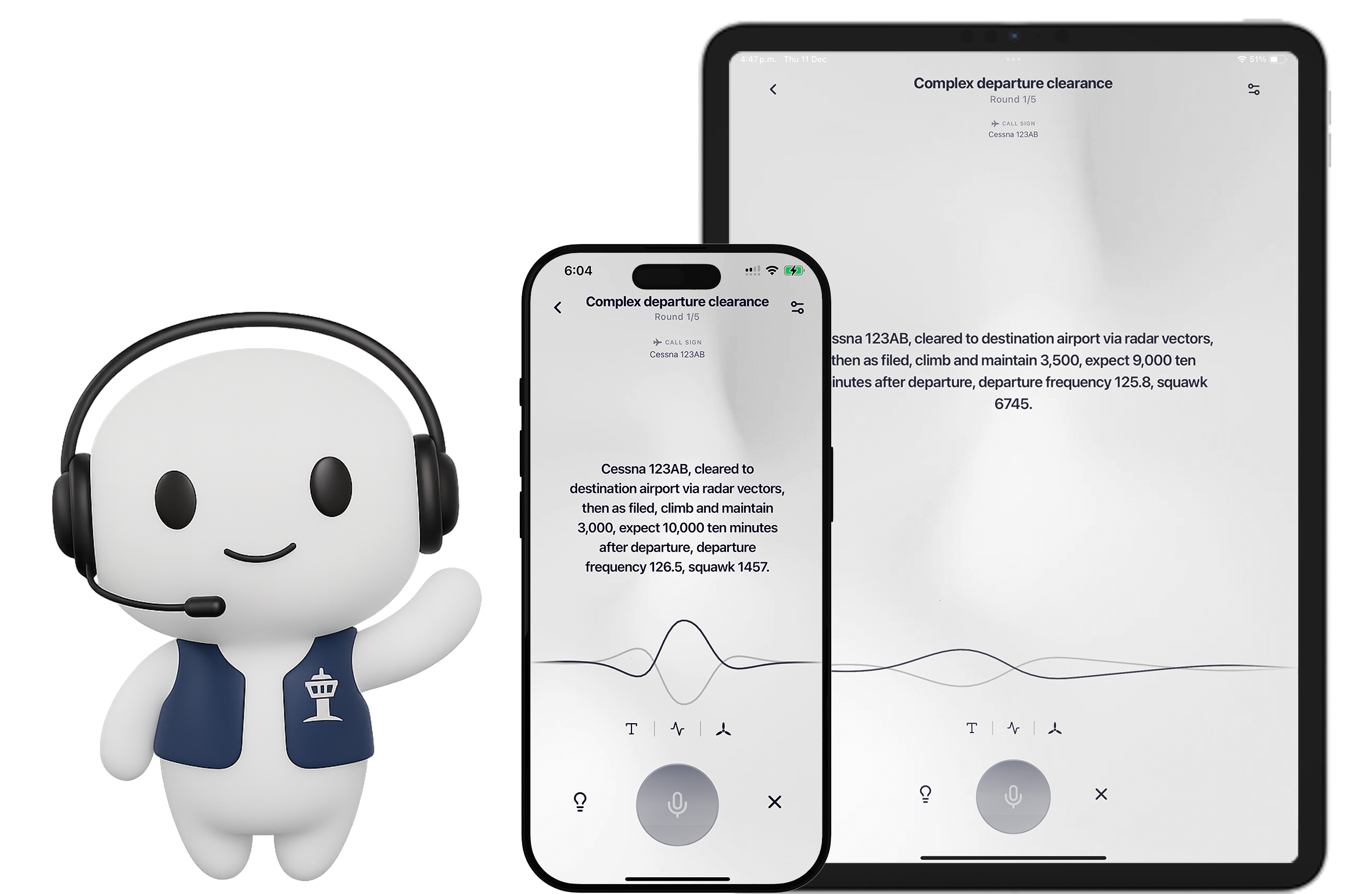
Listen and repeat ATC clearances and instructions to improve accuracy, retention, and note-taking skills.
- AI-generated clearances with realistic radio effects
- Practice taxi, takeoff clearances, and complex routing
- Instant feedback on accuracy and completeness
- Multiple difficulty levels from basic to advanced
Taxi Clearance Interpretation
Practice interpreting real-world ATC taxi clearances by drawing the exact route on intelligent airport diagrams. Your input is analyzed with high precision, allowing you to validate every turn, hold short, and runway crossing just like in real operations.
- Interactive airport diagrams with real-world layouts
- Practice complex taxi instructions, crossings, and hold positions
- Multiple difficulty levels across a variety of airports


ATIS Listening & Comprehension
Develop accurate ATIS comprehension and structured note-taking through realistic audio-based exercises. Work with dynamic ATIS transmissions in VFR, IFR, and mixed conditions, and validate your understanding through progressive evaluation.
- Information identifier, station, and time recognition
- Weather decoding (wind, visibility, clouds, altimeter)
- Runway usage and approach awareness
- NOTAM extraction and operational relevance
Holding Pattern Entries
Practice identifying and executing correct holding pattern entries based on real-world ATC clearances. Analyze each scenario and determine the appropriate entry method—direct, teardrop, or parallel—across varying headings, bearings, and wind conditions.
- Interpret holding clearances including fix, inbound course, and direction
- Determine correct entry procedures (direct, teardrop, parallel)
- Train with diverse scenarios and increasing complexity
- Reinforce situational awareness and IFR decision-making


Pilot Requests
Practice making clear and accurate pilot requests through realistic AI voice-based exercises. Receive a scenario and respond with the correct radio call, building confidence and precision in real-world communication.
- Formulate requests for taxi, departure, and enroute situations
- Apply correct phraseology and standard aviation terminology
- Improve clarity, timing, and structure in radio calls
Phrase builder
Develop accurate call structure and proper ATC phrase construction through guided, interactive exercises.
- Drag-and-drop interface to assemble correct calls
- Learn the proper order of information elements
- Instant validation with clear, detailed explanations


Written knowledge exams
Test your readiness for PPL (Private Pilot), IFR (Instrument Rating), and CPL (Commercial Pilot) knowledge exams, with a focus on ATC communications.
- Complete question bank covering all ATC topics
- Track knowledge retention over time
Built on professional standards
All scenarios and evaluations are based on FAA and ICAO standard phraseology and procedures, ensuring you learn the right way from the start. ATC One helps pilots practice real-world communications with professional aviation standards.
ATC One is an educational training tool designed to supplement formal aviation training. It is not a substitute for official flight training or certification. Always follow your instructor's guidance and official training materials.