
June 1, 2025
TrainingHow to practice ATC communications: apps, sims, and proven methods
Master radio communications faster with these proven practice methods. From free resources to professional apps, discover what works best.
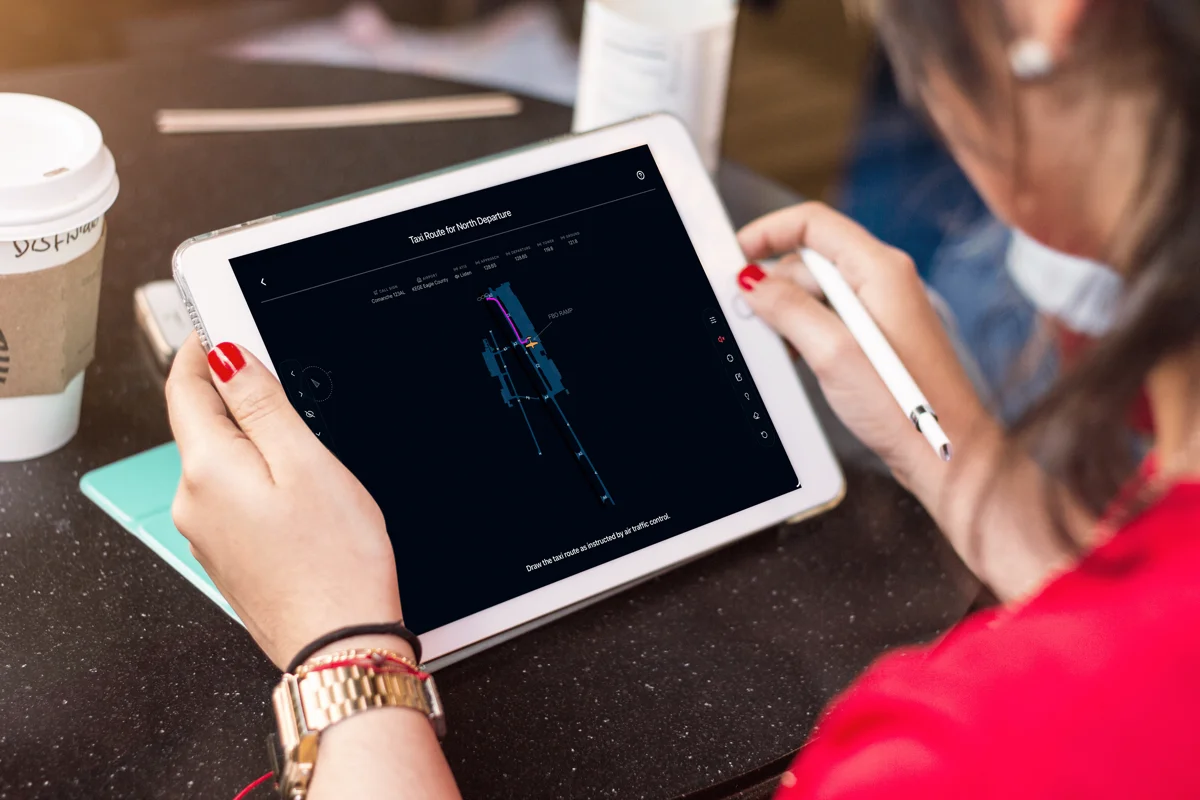
A complete guide covering everything you need to know. Estimated reading time: 14 min read.
Radio communications are the #1 source of anxiety for student pilots. The microphone feels intimidating, the phraseology sounds like a foreign language, and the fear of making mistakes is paralyzing.
But here's the good news: radio communications are a SKILL, not a talent. With the right practice methods, you can master them faster than you think.
This comprehensive guide covers every effective method for practicing ATC communications, from free resources to professional-grade tools.
Why practice matters (more than you think)
Time savings
Students who practice radio communications save an average of 3-5 flight hours during training. At $150-200/hour, that's $450-1,000 saved.
Confidence
Confidence on the radio translates to better overall flying. When you're not stressed about communications, you can focus on aircraft control and decision-making.
Safety
Clear, confident radio work improves safety. You're more likely to catch errors, ask clarifying questions, and communicate problems effectively.
Checkride performance
DPEs consistently report that students with strong radio skills perform better on checkrides overall. Communication competence creates a positive impression.
Method 1: Listening to real ATC (FREE)
Best for: Understanding rhythm, cadence, and real-world phraseology
LiveATC.net
What it is: Free website that streams live ATC communications from airports worldwide.
How to use it: 1. Choose an airport you plan to fly to 2. Listen to Tower or Approach frequency 3. Follow along with a sectional chart 4. Try to visualize what's happening 5. Note phraseology patterns
Advantages: - Completely free - Real controllers, real situations - Unlimited access - Hear different controller styles
Limitations: - Passive listening only (no practice speaking) - Can't control what you hear - May hear non-standard communications - No feedback on your performance
Pro tip: Listen for 15-20 minutes before each flight to the frequencies you'll use. This mental preparation is incredibly valuable.
Method 2: Chair flying with scripts (FREE)
Best for: Memorizing standard phraseology patterns
How to do it:
- Write out complete scripts for your next flight:
- - Taxi request
- - Takeoff request
- - Pattern position reports
- - Landing clearance expectation
- - Ground communications
- Practice out loud in a quiet room:
- - Read scripts naturally
- - Time yourself
- - Record yourself
- - Play it back
- Role-play both sides:
- - Be the pilot
- - Then be the controller responding
- - This builds understanding of what ATC needs
Advantages: - Free - Can practice anytime, anywhere - Builds muscle memory - Good for specific flights
Limitations: - No real-time feedback - Can't simulate unexpected situations - Boring/repetitive - No way to know if you're doing it right
Method 3: Practice with your CFI (PAID)
Best for: Personalized feedback and correction
Ground practice:
Schedule 30-minute ground sessions specifically for radio practice: - CFI plays controller - You practice realistic scenarios - CFI provides immediate corrections - Gradually increase complexity
Cost: $25-40 per session
Advantages: - Expert feedback - Personalized to your weaknesses - Can practice specific scenarios - Builds confidence before real flight
Limitations: - Expensive for frequent practice - Must schedule around CFI availability - CFI may not have extensive ATC background - Limited to imagination (no real ATC environment)
Method 4: Flight simulators with human ATC (PAID)
Best for: Realistic practice with full visual context
VATSIM (FREE) + Flight Simulator
What it is: Virtual ATC network with real humans playing controllers
Requirements: - Flight simulator (X-Plane, MSFS, P3D) - VATSIM account (free) - Basic simulator proficiency
Advantages: - Real humans as controllers - Free after simulator purchase - Full visual environment - Worldwide coverage
Limitations: - Requires flight sim setup ($60-300+) - Controller availability varies - Must fly the sim competently - Steep learning curve
PilotEdge (PAID - $20-30/month)
What it is: Professional ATC service for flight simulators
Advantages: - Professional controllers - Consistent coverage (West Coast USA) - Excellent for IFR practice - CAT ratings system tracks progress
Limitations: - Requires flight simulator - Monthly subscription - Limited geographic coverage - Must fly sim aircraft
Verdict: Excellent for IFR students and serious sim pilots, but overkill if you just want radio practice.
Method 5: Mobile apps (FREE to PAID)
Best for: Convenient, focused radio practice without full sim setup
This is where technology has revolutionized ATC practice. Let's compare the top apps:
ATC One (FREE tier + $19.99/month premium)
Technology: True AI (GPT-4 based)
What makes it different: - Genuine AI understands your intent, not just exact phrases - 200+ scenarios from basic to complex, VFR and IFR - Automatic pilot deviation detection catches your mistakes in real-time - Customizable realism - adjust background noise, radio static, controller speed - Detailed feedback explains WHY something was wrong and how to improve - Real airports practice at fields you'll actually fly to - Progressive difficulty adapts to your skill level
Best for: Serious students and professional pilots wanting most realistic practice
ROI: Most students save 3-5 flight hours = $450-1,000
Plane English ($14.99 one-time, iOS only)
Technology: Scripted responses with pattern matching
Pros: - Inexpensive one-time purchase - Good for learning basic patterns - Simple interface
Cons: - Breaks if you don't say things exactly as scripted - Limited scenarios (~40) - No background noise or realism - Basic feedback - VFR only
Best for: Budget-conscious beginners wanting basic pattern memorization
ARSim (Free with in-app purchases)
Technology: Pattern matching
Pros: - Free to try - Covers basics
Cons: - Very limited scenarios - Dated interface - Minimal feedback - Pattern matching often fails
Best for: Absolute beginners wanting to try for free before investing
Say Intentions (Free, web-based)
Technology: Pre-recorded audio playback
Pros: - Free - Uses real ATC recordings
Cons: - Just listening, not interactive - Can't practice speaking - No feedback
Best for: Supplemental listening practice only
The AI revolution: Why it matters
The difference between traditional scripted apps and AI-powered apps (like ATC One) is game-changing.
Traditional app problem:
You say: "Oakland Tower, Cessna 34 Bravo, downwind, 27 right."
App: ❌ ERROR - unrecognized. Say "Oakland Tower, Cessna 1234 Bravo, left downwind, runway 27 right."
The app breaks because you: - Shortened callsign (correct after initial contact) - Omitted "left" (implied by pattern) - Said "27 right" instead of "runway 27 right" (acceptable)
AI-powered app solution:
You say: "Oakland Tower, Cessna 34 Bravo, downwind, 27 right."
App: ✅ "Cessna 34 Bravo, runway 27 right, cleared to land."
Feedback: "Good position report. Including 'left' downwind and 'runway' 27 right is preferred for clarity, but your communication was understood."
This is exactly how real ATC works. They understand intent, not just exact phrases.
Comparison: Which practice method is best?
| Method | Cost | Effectiveness | Convenience | Realism | Feedback Quality |
|---|---|---|---|---|---|
| LiveATC | Free | ⭐⭐⭐ | ⭐⭐⭐⭐⭐ | ⭐⭐⭐⭐⭐ | None |
| Chair flying | Free | ⭐⭐ | ⭐⭐⭐⭐⭐ | ⭐ | None |
| CFI practice | $25-40/hr | ⭐⭐⭐⭐ | ⭐⭐ | ⭐⭐⭐ | ⭐⭐⭐⭐⭐ |
| VATSIM | $60-300 setup | ⭐⭐⭐⭐ | ⭐⭐ | ⭐⭐⭐⭐⭐ | ⭐⭐⭐ |
| PilotEdge | $20-30/mo + sim | ⭐⭐⭐⭐ | ⭐⭐ | ⭐⭐⭐⭐⭐ | ⭐⭐⭐⭐ |
| ATC One | $0-20/mo | ⭐⭐⭐⭐⭐ | ⭐⭐⭐⭐⭐ | ⭐⭐⭐⭐⭐ | ⭐⭐⭐⭐⭐ |
| Plane English | $15 one-time | ⭐⭐⭐ | ⭐⭐⭐⭐⭐ | ⭐⭐ | ⭐⭐ |
| ARSim | Free | ⭐⭐ | ⭐⭐⭐⭐ | ⭐ | ⭐ |
The optimal practice routine
Don't choose just one method—combine them for maximum effectiveness:
Daily (10-15 minutes): Use ATC One or similar app - Practice one scenario per day - Focus on weak areas - Review feedback carefully - Track progress
2-3 times per week (15-20 minutes): Listen to LiveATC - Airports you'll fly to - Follow along with chart - Note phraseology
Weekly (30 minutes): Chair fly your next flight - Write out complete scripts - Practice aloud - Record and review
Monthly (30-60 minutes): Ground session with CFI - Review areas of difficulty - Role-play complex scenarios - Get expert feedback
Before every flight (10 minutes): Specific preparation - Review frequencies - Practice expected calls - Listen to current ATIS/weather
Practice progression plan
Week 1-2: Foundation - Listen to LiveATC daily (passive) - Learn basic phraseology patterns - Chair fly simple pattern work - Start with beginner app scenarios
Week 3-4: Basic proficiency - Practice ground communications - Master pattern position reports - Add taxi and runway operations - Increase app difficulty to intermediate
Week 5-8: Controlled airports - Class D operations - Tower communications - Multiple runway environments - Practice clearance readbacks
Week 9-12: Complex operations - Class C transitions - Flight following - Special use airspace - Multiple frequency changes
Week 13+: Advanced scenarios - Class B operations - Unusual situations - Emergency communications - IFR procedures (if applicable)
Features that matter in practice tools
When choosing practice methods and apps, prioritize:
1. True AI over scripts AI understands intent; scripts only recognize exact matches.
2. Scenario variety More scenarios = better preparation for real-world diversity.
3. Customizable realism Ability to adjust background noise, radio quality prepares you for actual conditions.
4. Pilot deviation detection Tools that catch your mistakes build better habits.
5. Quality feedback Knowing WHAT was wrong AND WHY matters for improvement.
6. Progressive difficulty Start easy, build skills gradually, increase challenge.
Common mistakes in practice
Mistake #1: Passive listening only
Listening is valuable, but you MUST practice speaking. Radio work is a muscle—use it.
Mistake #2: Memorizing without understanding
Don't just memorize phrases. Understand WHY you're saying what you're saying.
Mistake #3: Perfect practice delusion
Real radio isn't perfect. Practice with static, background noise, interruptions.
Mistake #4: Inconsistent practice
10 minutes daily beats 2 hours once per week. Consistency is key.
Mistake #5: No feedback loop
Practice without feedback reinforces bad habits. Get corrections from CFI, apps, or AI.
The ROI calculation
Let's be honest about costs and value:
Traditional training (no practice): - Extra flight hours due to radio struggles: 3-5 hours - Cost: $450-1,000 - Stress and anxiety: High - Checkride confidence: Lower
With systematic practice: - Cost of app/tools: $0-150 - Extra flight hours saved: 3-5 hours - Actual savings: $300-850 - Stress and anxiety: Dramatically reduced - Checkride confidence: Much higher
The math is clear: Investing in quality practice tools pays for itself many times over.
Recommendations by student type
Budget-conscious beginner: - Start with LiveATC (free) - Add ARSim or Plane English ($0-15) - Graduate to ATC One free tier - Supplement with chair flying
Serious student pilot: - ATC One premium ($150/year) - LiveATC for listening - Regular CFI ground sessions - Total investment: ~$300 - Expected savings: $500-1,000
IFR student/professional: - ATC One for scenario practice - PilotEdge if you have flight sim - Regular practice with CFII - Total investment: ~$400-500/year - Value: Immeasurable for IFR proficiency
Conclusion
Mastering ATC communications requires practice—but the right KIND of practice matters.
The most effective combination: 1. Daily AI app practice (ATC One recommended) - 10 min 2. Regular LiveATC listening - 15 min, 3x/week 3. Chair flying before actual flights - 10 min 4. Monthly CFI review - 30 min
This routine will transform your radio confidence in 30-60 days.
Remember: Every professional pilot was once a nervous student on the radio. The difference isn't talent—it's practice.
Action item: This week, start with free resources (LiveATC, chair flying). Download a practice app (ATC One has free scenarios). Commit to 10 minutes daily for 30 days. Track your confidence level weekly. You'll be amazed at the progress.
Ready to practice what you just learned?
Reading is great, but real improvement comes from practice. ATC One lets you practice these exact scenarios with AI-powered voice recognition. Get instant feedback, build confidence, and master communications before your next flight.
About the author
Continue learning
 Training
ATC phraseology cheat sheet: the 20 most used phrases
Memorize these 20 essential phrases and you'll be ready for 90% of your communications. Includes pronunciation and real examples.
 Training
Traffic pattern communications: complete guide
Master communications for each leg of the pattern. Learn exactly what to say, when to say it, and how to stay safe in busy traffic.
 Training
Understanding ATIS: complete breakdown for student pilots
ATIS can sound like gibberish at first. Learn to decode every section and know exactly what to write down.